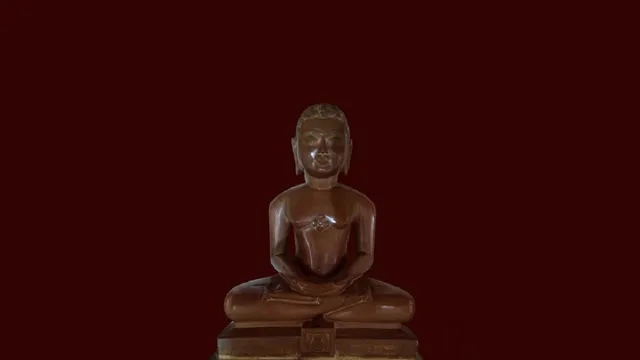
Sutras of liberation — the eternal Jain wisdom held in the spirit of Mallinath Bhagwan, calling the soul to conduct of the highest order.

The teachings preserved in the spirit of Mallinath Bhagwan are not theories to be debated, but living practices to be inhabited. They form a precise and ancient map of the inner life — a discipline of speech, action and thought that gradually dissolves the karmic substance binding the soul to the cycles of birth.
Each principle below is a doorway. To walk through one is to begin walking through them all.
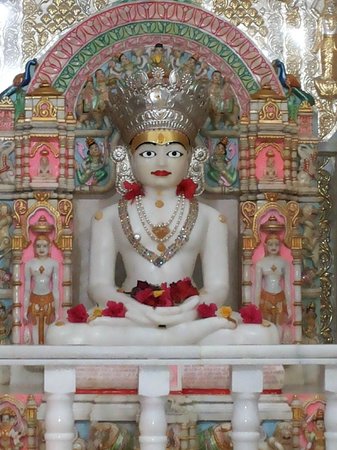
Five eternal vows that form the inner architecture of a liberated life.
To wound no living being — in thought, word or action. Ahimsa is not mere abstention; it is the active radiance of compassion that holds all life as kin.
To speak that which is true, kind and beneficial. The Jain ideal of truth is a courageous alignment of inner life with outer expression.
To take nothing — material or subtle — that has not been freely given. Asteya extends to time, attention, ideas and the sacred labour of others.
To conserve life-force and direct the senses toward the awakening of consciousness — the inward focus of one whose home is the soul.
To hold nothing — not wealth, not identity, not outcomes — as the soul’s own. Aparigraha frees the inner space in which liberation can dawn.
To see reality as it truly is, with eyes washed of delusion — perceiving the soul, the cosmos and karma in their true relationship.
Right Faith, Right Knowledge, Right Conduct — the three jewels together form the path. Walk all three, for one without the others is a torch without flame. — The Ratnatraya of Jain dharma

Mallinath Bhagwan’s life itself becomes the supreme teaching: the recognition that every external possession — wealth, status, even one’s own bodily form — is impermanent, and that clinging to such forms is the very root of suffering.
Detachment, in the Jain sense, is not coldness. It is, paradoxically, the deepest form of love — for it relates to all beings without ownership, with the spaciousness of one whose heart needs nothing in return.
The daily practice of equanimity — sitting in stillness to dissolve agitation and recover the soul’s native steadiness.
Sacred study — drawing nourishment from the Agamas and the wisdom transmitted by the awakened ones.
Inner austerity — the gentle, disciplined fire that purifies subtle attachments and awakens dormant capacities of the soul.
Meditative absorption — resting awareness in the soul itself, free of thought-stream, free of mental colouring.